Unlock enterprise data for agentic AI workflows. Instantly make existing APIs AI-ready, with no code changes required.

OpenAI
Claude
Mistral
Gemini
Any LLM
Native API to MCP Translation
Curate tools for optimal AI integration
Token & Cost efficiency
Enterprise grade security, authentication and logging
GraphQL
gRPC

SOAP
OpenAPI
Any API

AI  that delivers

Research has proven that AI projects need access to company data to deliver real value. AppFactor’s MCP Bridge instantly delivers enterprise data access for building production-ready AI workflows and agentic systems at scale.

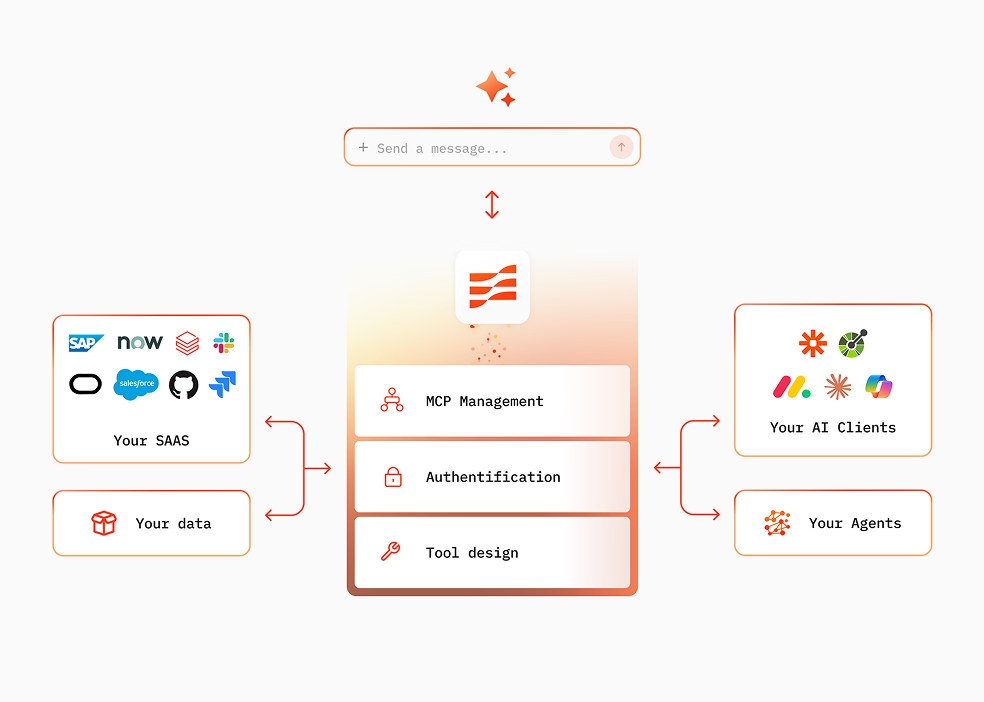
AppFactor enables teams to seamlessly expose, govern, and optimize LLM, MCP and API resources, through a single point of control, eliminating integration complexity without creating and maintaining hundreds of individual MCP servers.

How it works

Introducing the AppFactor MCP Bridge.

Build valuable AI agents and workflows without creating a technical debt timebomb. Connect and modernize existing systems and APIs for Generative AI, without having to create, deploy and maintain a multitude of MCP servers.

Why MCP Bridge

How is the AppFactor MCP Bridge different from a Gateway?

Capability
MCP Gateway
AppFactor MCP Bridge
Native API to MCP Protocol Translation
no
yes
Customizable cross-system MCP tool definittion
no
yes
Faster Model Responses
no
yes
Efficient Token Usage
no
yes
Centralized Policy
yes
yes
Enterprise grade security
yes
yes
Consistent Authorization
yes
yes
Full Audit Logging
yes
yes

Seamless AI connectivity

Key benefits of the AppFactor MCP Bridge.

Zero code AI integration

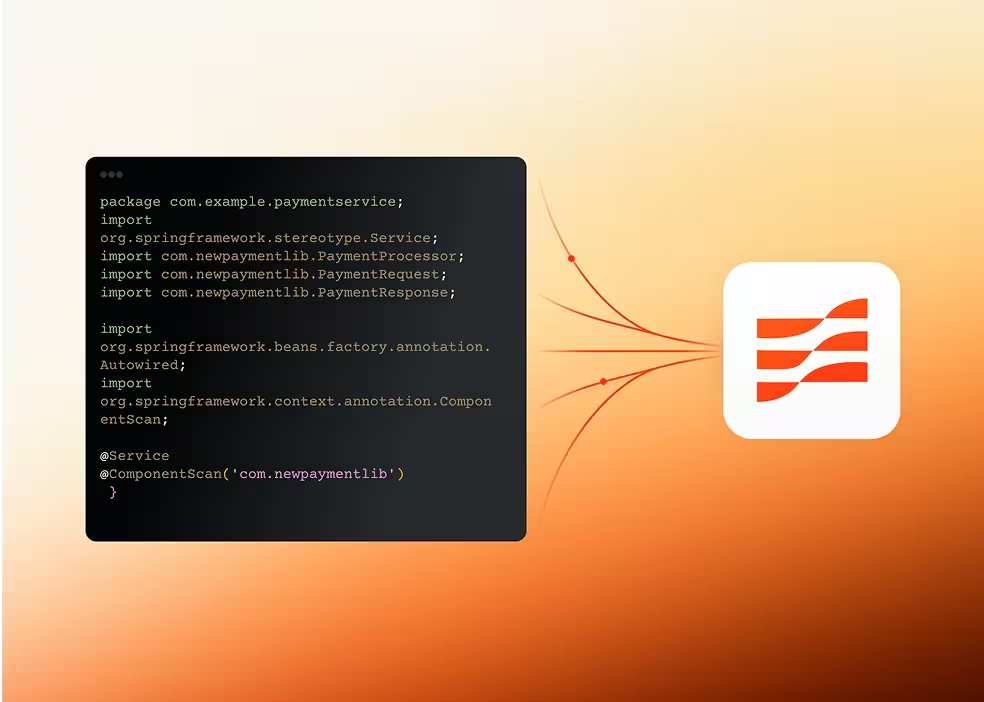
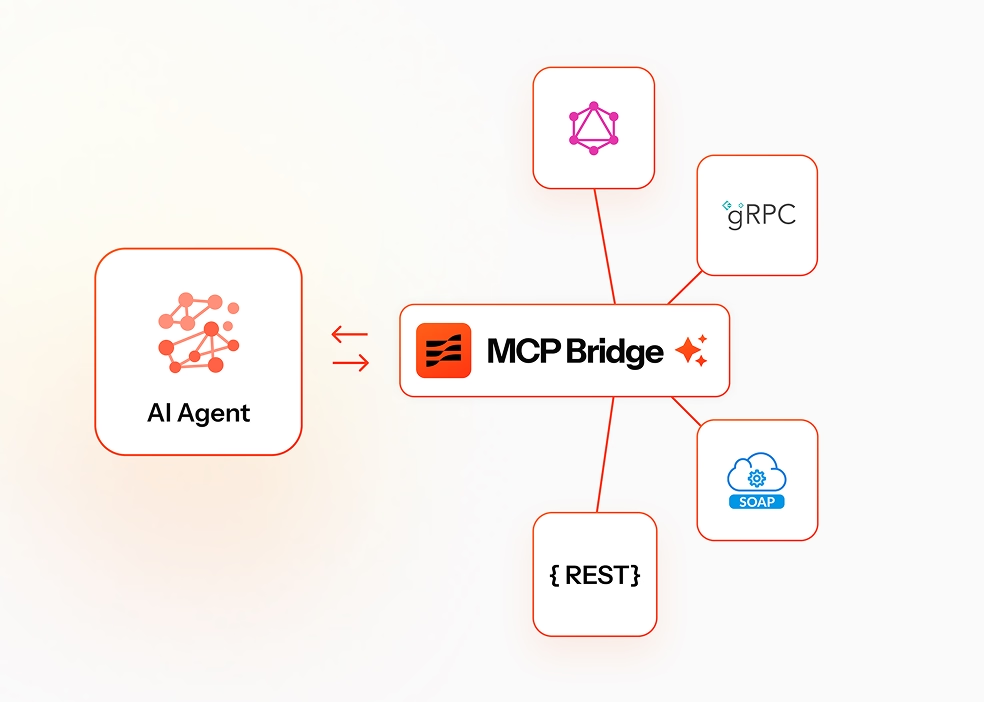
Transform any existing API into MCP-ready infrastructure without writing or maintaining custom MCP server code or modifying API's - REST, GraphQL, gRPC, SOAP, legacy — it all becomes AI-Ready from a single configuration, eliminating development overhead and technical debt.

Connects to every system through a single bridge

Support for any API means teams can integrate legacy and modern applications through one consistent interface. This gives customers full flexibility to include every system in their agentic workflows.

Improves governance and reduces security risk

MCP Bridge is built for Enterprise with centralized auth (OAuth), token refreshes, rate limiting, activity audits and observability.

Smarter AI through tool curation

Instead of connecting raw API endpoints to LLMs and hoping for the best, MCP Bridge lets you scope tools to relevant operations, enrich them with context and metadata, and compose multi-step workflows into single tool calls. The result is AI that picks the right tools and delivers accurate results with less token consumption.

Use cases

MCP Bridge use cases.

Legacy system data access
Consolidating Agent Access Control
Agent Performance Improvements
Legacy system data access

MCP Bridge is the context layer for agentic applications.

Transform any existing API into MCP-ready infrastructure without writing or maintaining custom MCP server code or modifying API code for REST, GraphQL, gRPC, SOAP and legacy systems.

Consolidating Agent Access Control

MCP infrastructure built for enterprise scale.

Bloating an LLM's context window costs you money. AppFactor Bridge scopes your APIs to only the relevant operations, enriches them with context and generates a tooling script so agents pick the right tool first time, and orchestrates complex workflows in a single call instead of many.

Optimize agentic costs and performance

Spend less on tokens, get more from your agents.

Ensure efficient access that lowers operating costs and improves agent responsiveness

Product capabilities

Enterprise ready product capabilities.

Capability

What it does

Why it matters

Protocol Translation

Converts MCP tool requests into target systems native protocol: REST, GraphQL,gRPC,SOAP, etc.

Connects and optimizes legacy and new systems to LLMs without writing or maintaining MCP code.

Data Formatting

Translates between MCP’s JSOPN-RPC format and other systems data models.

Allows LLM to access data from any source.

Identity and Access Management

Two levels: Agent to be able to use MCP server OAuth 2.0 between MCP Server and MCP Bridge. Bearer Token, OAuth 2.0, basic authentication and API Key  support for API Access.

Maintain least privilege access control to sensitive data.

Security Controls

Security policies, logging, encryption and secrets management.

Protects company data and provides visibility and traceability across agentic workflows.

Scalability

Highly performant, low latency with flexible deployments

Designed to handle the highest levesl of requests and throughput

Connection Management

Handle connection pooling, retry logic for API calls, API call throttling and automatic schema refresh.

Delivers consistent workflow performance.

  • Protocol Translation

    What it does

    Converts MCP tool requests into target systems native protocol: REST, GraphQL,gRPC,SOAP, etc

    Why it matters

    Connects legacy and new systems to LLMs without writing or maintaining code

  • Data Formatting

    What it does

    Translates between MCP’s JSOPN-RPC format and other systems data models.

    Why it matters

    Allows LLM to access data from any source.

  • Identity and Access Management

    What it does

    Two levels: Agent to be able to use MCP server OAuth 2.0 between MCP Server and MCP Bridge. Bearer Token, OAuth 2.0, basic authentication and API Key  support for API Access.

    Why it matters

    Maintain least privilege access control to sensitive data.

  • Security Controls

    What it does

    Security policies, logging, encryption and secrets management.

    Why it matters

    Protects company data provides visibility and traceability across agentic workflows.

  • Scalability

    What it does

    MCP Bridge Runs as a Serverless Function (Lambda) for essentially immediate response.

    Why it matters

    Provides the ability to scale out to as many instances as needed.

  • Connection Management

    What it does

    Handle connection pooling, retry logic for API calls, API call throttling and automatic schema refresh.

    Why it matters

    Delivers consistent workflow performance.

Give your AI Agents the data access they need.

Contact us
Contact us

FAQ

  • What APIs are supported?

    The MCP Bridge handles REST, SOAP, GraphQL, proprietary APIs, and MCP without requiring vendor MCP implementations or custom code to built and maintain.

  • How is this different from an MCP Gateway?

    API Gateways handle traffic routing, auth, and rate limiting for APIs that are already REST/OpenAPI-compatible. They sit in front of your existing APIs and manage the flow - but they still expect a standardized input format.

    If your backend is GraphQL, gRPC, SOAP, or a custom or non-conforming protocol, you'd need to write adapter code yourself.

    AppFactor MCP Bridge does something fundamentally different - it translates protocols. It takes a non-MCP system (REST, GraphQL, gRPC, SOAP, legacy/proprietary) and converts requests and responses between MCP and that system's native protocol.

  • Can I connect MCP servers if my products already support them?

    Yes

  • What Authorization standards are supported?

    OAuth, Single Sign On

  • Can I create custom MCP tools?

    Yes, the system enables the definition of custom MCP tools that span across different endpoints

  • How can I try it out?

    MCP Bridge is available to trial and buy at AWS Marketplace and Azure Marketplace.